You do not need a dedicated gym to work on your handstand goals. But a small training area needs careful planning, and some rooms simply are not suitable for going upside down.
The aim is not to squeeze a handstand into the smallest possible gap. It is to choose practice that fits the space you actually have, including enough room to enter, move and exit without hitting anything.
Here is how to assess your setup before your next home session.
Start with the movement, not the equipment
Different exercises need different amounts of room. A controlled floor conditioning exercise has a different footprint from a kick-up, and a handstand exit may take you beyond the spot where your hands started.
Decide what you intend to practise before moving furniture or setting out equipment. Consider the whole movement, including what could happen if you lose balance.
If you cannot provide the space needed for a controlled exit, choose a different exercise or train somewhere else. A clear patch for your hands alone is not enough.
Check overhead clearance
Look up as well as around. Ceiling height, hanging lights, fans, shelves and sloping ceilings can all limit your training area.
Your feet may travel beyond their final position during an entry or an unexpected movement. Do not judge clearance solely by where you expect to finish a successful hold.
Raised equipment changes the setup too. Blocks, parallettes and canes lift your hands above the floor, so reassess the available height whenever you change equipment. If you are uncertain, do not test the ceiling clearance by kicking up.
Make your exit route a priority
Handstand practice should include an exit you already know how to perform safely. Learn that with appropriate coaching and in a suitable environment, not for the first time between your sofa and a coffee table.
Keep the surrounding area free of furniture, loose objects, sharp edges and anything you could land on. Close off the space to pets and other people who might walk through unexpectedly.
A wall does not remove the need for a clear exit route. Supported practice still involves moving into and out of the position, and losing control remains possible.
Choose a suitable floor
The floor should be level and appropriate for the exercise and equipment you are using. Wet, dusty or uneven surfaces are not suitable training conditions.
Check whether your hands and equipment remain secure during a familiar, controlled movement. Do not assume a surface is appropriate because it looks clean or because your kit has non-slip pads.
Rugs and loose mats can shift. Very soft surfaces can also change the stability of hand support or equipment. Follow your equipment's instructions and seek coaching advice about the surface and any matting needed for your practice.
Do not improvise extra height by stacking equipment, placing blocks on furniture or building supports from household objects.
Using a wall? Check the wall too
A wall is a training aid only when the surface and surrounding space are suitable. Avoid glass, mirrors, doors, radiators, shelves and fixtures. Do not rely on a surface whose suitability you cannot establish.
Choose wall-supported exercises that match your current ability and leave enough space to get down in a controlled way. Wall walks and unfamiliar transitions are not automatically beginner-friendly simply because the wall is there.
Use a coach's guidance for hand placement and progression. There is no universal distance from the wall that suits every body, exercise and level.
Keep your setup simple
A small area benefits from less clutter, not more kit. Put out only what you need for the session and store unused equipment outside the movement area.
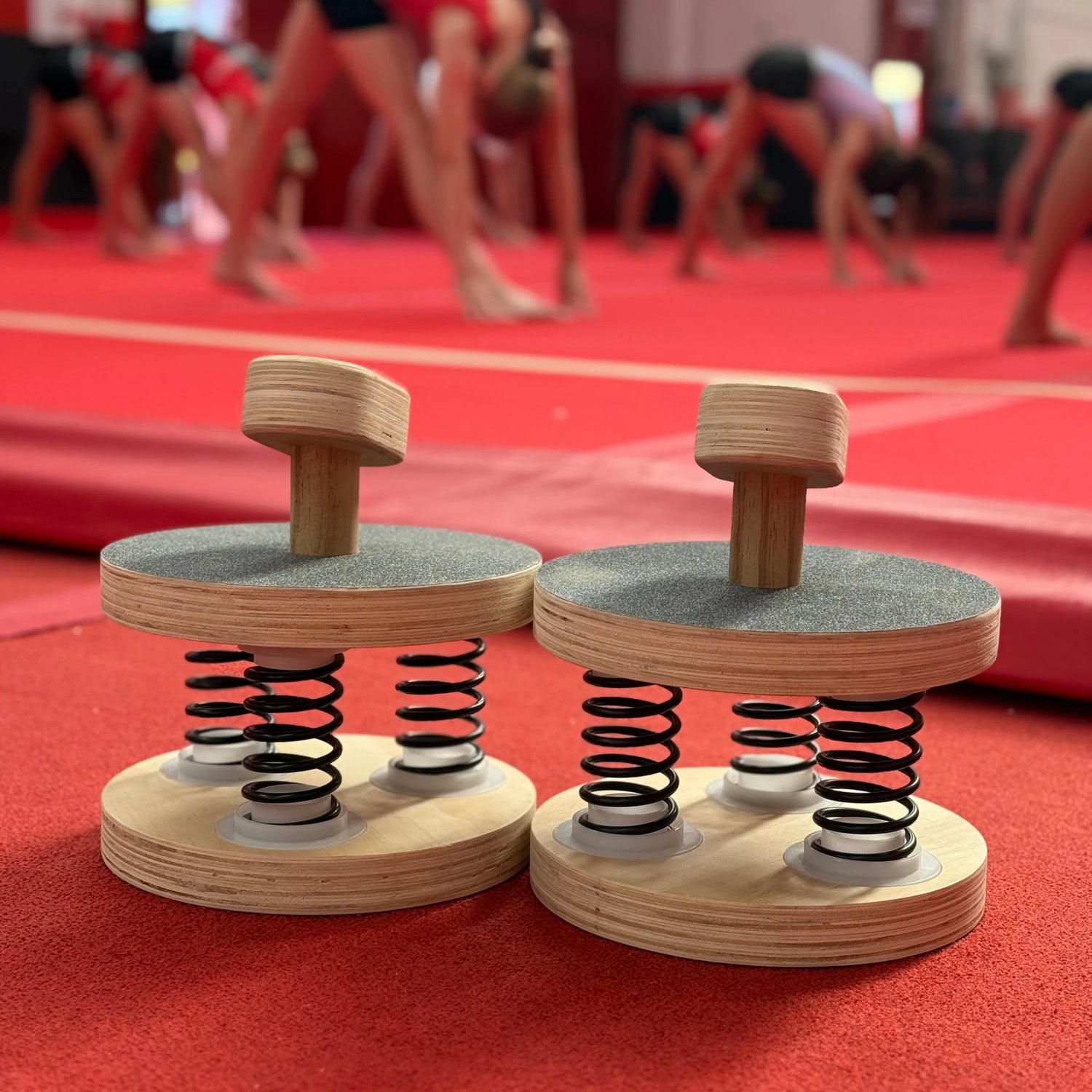
If you use blocks or parallettes, check their condition, placement and contact with the floor before training. Position separate pieces according to the product instructions and your intended exercise.
A phone or tripod belongs outside the landing area. Film only if you can do so without reducing the space you need to train.
What can you practise when there is not enough room for a handstand?
A useful home session does not have to include an inversion. When the room is unsuitable, work on familiar conditioning, coordination or mobility exercises prescribed for your goals by a qualified coach.
You might use the session to review training footage, plan your next coached practice or complete an appropriate floor-based routine. Choose movements you can control comfortably within the space available.
Do not replace a full handstand with an improvised version against furniture. If the setup is unsuitable, changing the plan is the sensible training decision.
There is no single minimum room size
The space you need depends on your height, the exercise, your equipment, your entry and exit technique, and the surrounding hazards. A measurement that works for one athlete may not work for another.
That is why assessing the full movement matters more than following an arbitrary floor-area rule. If you are unsure whether your room is suitable, show the setup to a qualified coach before attempting the skill there.
Your pre-session space checklist
- Is the exercise appropriate for my current ability?
- Have I checked the full entry, hold and exit area?
- Is there adequate overhead clearance, including above raised equipment?
- Is the floor level, clean, dry and suitable?
- Is the wall suitable if my exercise uses it?
- Are furniture, pets, people and filming equipment outside the movement area?
- Have I checked my equipment and followed its setup instructions?
- Can I stop and exit in a controlled way?
If any answer is uncertain, adjust the session before starting. Stop if you experience pain, lose control or find that the setup moves unexpectedly.
For parents setting up a practice area
Children need age-appropriate exercises, suitable supervision and guidance from their coach. An uncluttered room is useful, but it does not make every gymnastics skill appropriate for home practice.
Ask the coach which exercises your child can practise at home and what space and support they require. Do not attempt spotting techniques you have not been trained to use.
The takeaway
A good small-space training setup starts with an honest assessment of what the room can accommodate. Clear the area, check the floor and overhead space, and make sure your exit is part of the plan.
When there is not enough room, choose another exercise or another location. Adapting your session is better than forcing a skill into an unsuitable space.
Looking for kit for your training setup? Visit Balance Addicts to explore our products and choose equipment that suits your goals and available space.