Whether you've just nailed your first cartwheel or you've been training for a few months and want to take things to the next level, the jump from beginner to intermediate gymnastics is one of the most exciting — and most misunderstood — stages of the journey.
It's not about doing harder skills. It's about building the foundations so solidly that harder skills become inevitable.
Here's exactly how to make that progression, step by step.
What Does "Intermediate" Actually Mean?
Before you can progress to intermediate, it helps to know what you're aiming for. At an intermediate level, you should be able to:
- Hold a straight, controlled handstand against the wall for 30+ seconds
- Perform a clean cartwheel with straight arms and legs
- Complete a forward and backward roll with control
- Hold a bridge with fully extended arms and open shoulders
- Demonstrate basic flexibility: flat splits or close to it, and a solid pike stretch
If you can do most of these consistently, you're already on your way. If not, these are your targets.
1. Stop Rushing the Fundamentals
The single biggest mistake beginners make is trying to skip ahead. It's tempting to chase the flashy skills — back walkovers, aerial cartwheels, one-arm handstands — but every one of those skills is built on a foundation of basics done really, really well.
Spend time getting your cartwheel truly clean before moving to a round-off. Get your round-off dialled before attempting a back handspring. Get your wall handstand solid before working freestanding. Rushing past the basics doesn't save time — it costs it.
2. Build a Consistent Training Schedule
Gymnastics is a skill sport. Your nervous system needs regular, repeated exposure to movements to build the coordination and muscle memory required to perform them well.
Three to four sessions per week of 30–45 minutes will produce far better results than one long session at the weekend. Even 20 minutes of focused daily practice — working on a handstand, stretching your splits, drilling a cartwheel — will compound into significant progress over weeks and months.
Consistency beats intensity every time.
3. Train Your Handstand Seriously
The handstand is the cornerstone of gymnastics progression. Almost every intermediate and advanced skill either starts from, passes through, or requires the body awareness developed by handstand training.
If you're not already training your handstand daily, start now. Work through this progression:
- Wall handstand hold — build to 60 seconds with a straight, tight body
- Chest-to-wall handstand — develops the shoulder alignment needed for a freestanding hold
- Kick-up practice — work on consistent, controlled kick-ups rather than wild attempts
- Balance attempts — once your wall hold is solid, start taking small balance attempts away from the wall
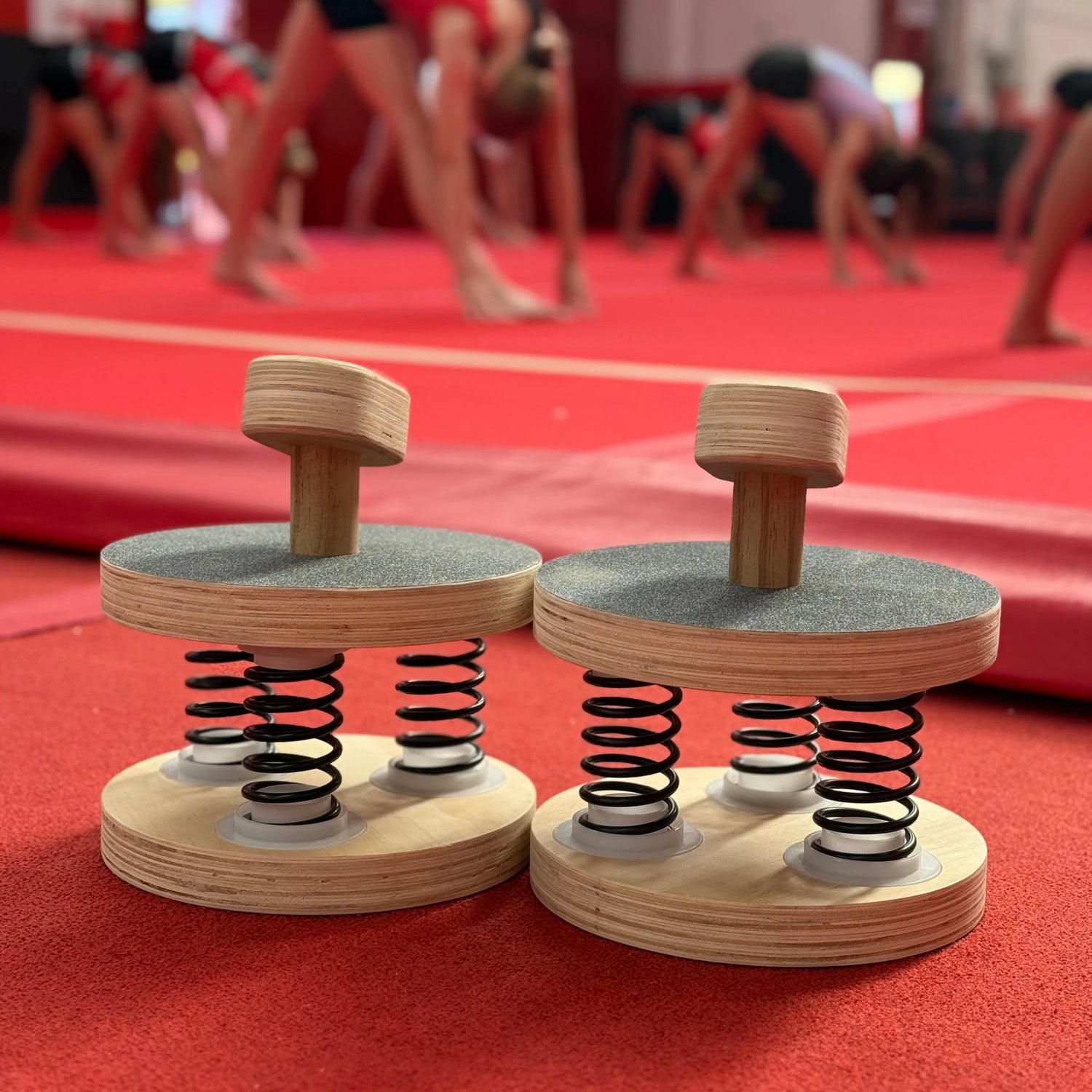
Using handstand blocks from the start is a smart move — they reduce wrist strain, improve your grip, and allow you to train longer and more frequently without discomfort. Our Balance Addicts Handstand Blocks are designed specifically for home training and are a brilliant investment at this stage.
4. Work on Flexibility Every Day
Flexibility is one of the most important physical qualities in gymnastics, and unlike strength, it responds best to daily work. Even 10–15 minutes of stretching before bed will produce noticeable improvements within a few weeks.
Focus on:
- Hamstrings and hip flexors — essential for splits, kicks, and leg lines
- Shoulders and thoracic spine — critical for bridges, back walkovers, and handstand alignment
- Wrists — often neglected but vital for comfortable handstand training
Don't treat flexibility as an afterthought. Build it into every session.
5. Add Conditioning to Your Routine
Intermediate gymnastics requires real strength — particularly in the core, shoulders, and legs. If you're not conditioning alongside your skill work, you'll hit a ceiling quickly.
Key exercises to include:
- Hollow body holds and rocks — the foundation of gymnastics body tension
- Pike compressions — builds the hip flexor strength needed for L-sits and leg lifts
- Shoulder taps in plank — develops the stability needed for handstand balance
- Glute bridges and single-leg work — supports cartwheel and walkover mechanics
Adding gymnastics ankle weights to your conditioning work is a simple but highly effective way to build the leg strength that underpins almost every gymnastics skill. Our Balance Addicts Gymnastics Ankle Weights are comfortable, adjustable, and perfect for home use.
6. Film Yourself Training
This is one of the most underused tools available to home gymnasts — and it's completely free. Filming your sessions gives you an objective view of what your body is actually doing, which is often very different from what it feels like you're doing.
Watch your footage back and look for specifics: are your arms straight in your handstand? Are your hips square in your cartwheel? Is your bridge high enough? Identifying these details visually is far more effective than trying to feel your way to improvement.
7. Set Milestone Goals, Not Vague Ones
"Get better at gymnastics" is not a goal. "Hold a freestanding handstand for 5 seconds by the end of the month" is.
Break your progression into specific, measurable milestones and track them. When you hit one, celebrate it — then set the next one. This keeps training purposeful and gives you a clear sense of progress, even when improvement feels slow.
8. Be Patient — Progress Is Not Linear
There will be weeks where everything clicks and weeks where nothing does. That's completely normal. Gymnastics progress is not a straight line — it's a series of plateaus punctuated by breakthroughs.
The gymnasts who reach intermediate level aren't the most talented ones. They're the ones who kept showing up consistently, even when progress felt invisible.
The Bottom Line
Progressing from beginner to intermediate gymnastics comes down to mastering the basics, training consistently, building your handstand, and developing the flexibility and strength to support your skills. Do those things — with the right equipment and the right mindset — and intermediate level is well within reach.
At Balance Addicts, we've got everything you need to support your gymnastics journey at home. Explore our full range at balanceaddicts.com and find the tools that will help you train smarter and progress faster.
Now get to work. Your intermediate self is waiting. 💪🤸