Introduction
If you've spent any time in the fitness world, you've probably heard the words "balance" and "stability" used interchangeably. But are they actually the same thing? The short answer is no — and understanding the difference could be the key to unlocking better performance, fewer injuries, and smarter training.
In this article, we break down exactly what balance and stability mean, how they differ, and why both matter for gymnasts, handstand practitioners, and anyone serious about movement quality.
What Is Balance?
Balance is your body's ability to maintain its centre of mass over its base of support — whether you're moving or still. It's a dynamic, reactive skill that relies on constant input from three systems:
- The vestibular system — your inner ear, which detects head position and movement
- The visual system — your eyes, which provide spatial orientation cues
- The proprioceptive system — sensors in your muscles, joints, and tendons that tell your brain where your body is in space
Balance is what keeps you upright on a wobble board, allows you to hold a handstand, or lets you walk a balance beam without toppling over. It's fundamentally about control in the face of instability.
What Is Stability?
Stability, on the other hand, is your body's ability to resist unwanted movement — particularly at a joint or through the spine. It's less about reacting to external forces and more about generating internal tension to hold a position firm.
Think of stability as the foundation that balance is built on. A stable shoulder joint allows you to press into a handstand. A stable core allows you to transfer force efficiently without energy leaking through your midsection. Without stability, balance becomes chaotic and unsustainable.
Stability is largely a function of:
- Muscular co-contraction — opposing muscle groups working together to stiffen a joint
- Neuromuscular control — the brain's ability to recruit the right muscles at the right time
- Structural integrity — the passive support of ligaments, tendons, and joint capsules
Key Differences at a Glance
| Balance | Stability | |
|---|---|---|
| Definition | Maintaining centre of mass over base of support | Resisting unwanted movement at a joint or segment |
| Nature | Dynamic and reactive | Active and resistive |
| Primary systems | Vestibular, visual, proprioceptive | Muscular, neuromuscular, structural |
| Example | Holding a handstand on a wobble block | Keeping your wrists locked during a handstand press |
Why Both Matter for Training
Here's where it gets practical. Many athletes focus heavily on one at the expense of the other — and both approaches have blind spots.
Training balance without stability
If you jump straight into balance challenges (like wobble boards or single-leg drills) without building adequate joint stability first, you're essentially building on a shaky foundation. You may develop compensatory movement patterns, increase injury risk, or plateau quickly because your joints can't handle the load.
Training stability without balance
On the flip side, athletes who only train in stable, controlled environments (like flat-ground strength work) often struggle when they're placed in unpredictable situations. Their muscles are strong, but their nervous system hasn't been trained to react quickly to perturbations.
The sweet spot is training both — progressively and intentionally.
How to Train Both Effectively
Build stability first
Before adding instability, make sure you have solid joint stability in the positions you're training. For handstands, this means developing shoulder packing, wrist strength, and core tension. For lower body work, it means hip and ankle stability before progressing to single-leg or unstable surface training.
Introduce balance challenges progressively
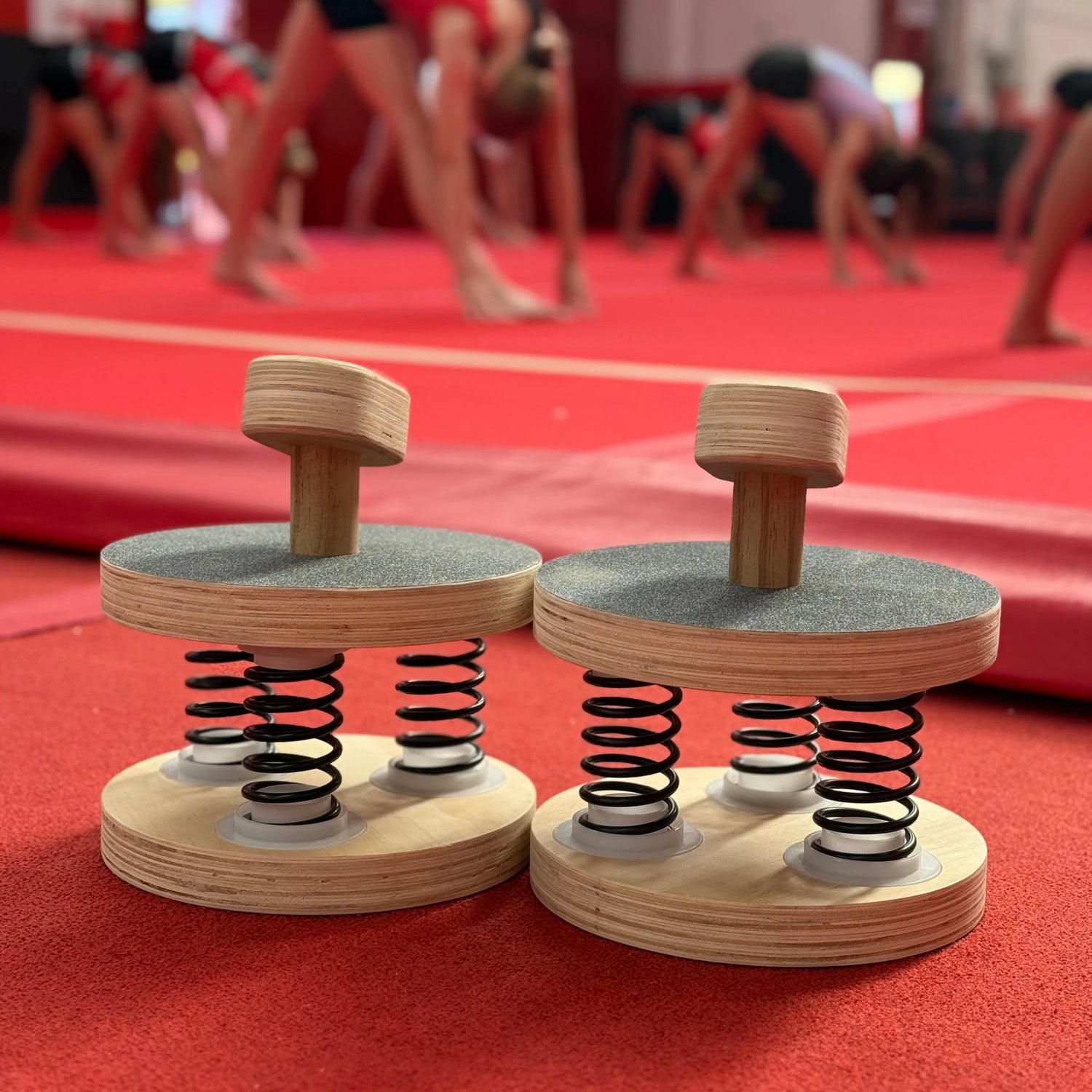
Once you have a stable base, tools like wobble blocks, balance boards, and balance mats are excellent for challenging your proprioceptive system and developing reactive balance. Start with wider bases of support and progress to narrower ones as your skill improves.
Train in multiple planes
Balance and stability aren't just front-to-back challenges. Train lateral and rotational stability too — this is where many athletes have significant gaps.
Close your eyes
Removing visual input forces your vestibular and proprioceptive systems to work harder. Try holding a balance position with eyes closed to expose weaknesses and accelerate adaptation.
Balance and Stability in Handstand Training
Handstand training is one of the most demanding tests of both balance and stability simultaneously. You need:
- Shoulder stability to support your bodyweight overhead without collapsing
- Wrist stability to make micro-adjustments without injury
- Core stability to maintain a rigid, hollow body position
- Balance to make constant, tiny corrections through your fingers and wrists to stay upright
This is why handstand training is such a powerful tool for overall movement quality — it demands both systems working in harmony.
Final Thoughts
Balance and stability are complementary qualities, not competing ones. Think of stability as the platform and balance as the skill built on top of it. Train both deliberately, progress sensibly, and you'll move better, perform better, and stay injury-free for longer.
Ready to challenge your balance and stability? Explore our range of training equipment designed to help you build both qualities from the ground up:
- Balance Addicts Handstand Wobble Blocks — the ultimate tool for developing reactive balance and proprioception
- Wobble Block Training Kit — everything you need to start your wobble block training journey
- Balance Addicts Handstand Balance Mat — a non-slip surface for safe, confident balance training
- Balance Addicts Handstand Blocks — build shoulder stability and wrist strength for handstand mastery